
Ideas That Bloom Off the Beaten Path
Speculative Design & World - Building
This is where design wanders a little further, asks stranger questions, and grows into possibilities that don’t quite play by the rules. My speculative work explores the what ifs, the playful, the provocative, and the quietly rebellious ideas that challenge how we think, live, and connect. Each concept is rooted in curiosity and nurtured with imagination, blooming into visions of what the world could look like if we let creativity run a little wild.
1.
The Ubomi Project
Project: Speculative design narrative set in South Africa in the year 2125
2025
The Ubomi Project is a speculative design narrative set in South Africa in the year 2125, where environmental collapse has divided society between elites living in climate-controlled domes and the masses struggling to survive outside them. At the centre of this dystopian future is Ubomi Co., a powerful biotech corporation cultivating the Lilium Ubomiensis, a flower said to grant vitality and longevity. Beneath its promise of renewal lies a harrowing truth: the plant only thrives in soil nourished by human remains, transforming the disappeared and forgotten into the literal foundation of elite survival.
Visually rooted in Delftware, the project contrasts delicate beauty with concealed horror. The refined blue-and-white aesthetic, historically associated with heritage and luxury, is reimagined as a corporate mask, concealing atrocity beneath ornamentation. This stylistic choice reflects how systems of exploitation persist through time, disguised as progress and refinement. In The Ubomi Project, elegance becomes propaganda, and beauty becomes a vessel for moral decay.
Through three interconnected artefacts, the Bloom Pod, Ubomi Tea, and the Docket of Silence, the project reveals fragments of a suppressed history. Each object serves as evidence left behind by a whistleblower seeking to expose the truth, guiding viewers through a world where design becomes both weapon and witness. Together, these artefacts invite reflection on complicity, desire, and the ethics of consumption in an age where even life itself is commodified.
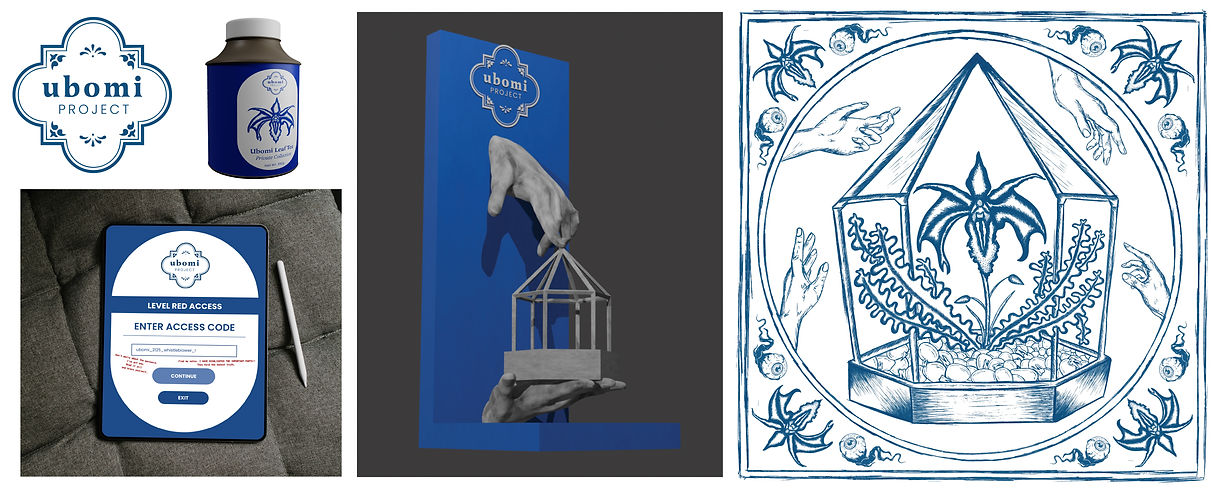
The Truth Beneath the Glaze
Drawing from Delftware’s fragile beauty, The Ubomi Project presents artefacts that appear refined, yet hold darkness within. It invites viewers to look closer, to see how horror can be hidden beneath the surface of perfection, and how design can both conceal and expose truth.
Artefact One: The Bloom Pod Terrarium
The Bloom Pod introduces Lilium Ubomiensis as a luxury biotech product—an exquisite flower displayed in a pristine glass terrarium. Beneath its elegance, however, lie human teeth embedded in the soil, symbolising the exploitation hidden beneath Ubomi Co.’s promise of vitality. Designed as a point-of-sale display, the Bloom Pod mirrors consumer culture’s ability to transform horror into desire, forcing viewers to confront how easily ethics can be obscured by beauty and branding.


Artefact Two: Ubomi Tea and Packaging
Ubomi Tea explores how the elite of 2125 consume immortality as ritual. Brewed from the petals of Lilium Ubomiensis, the tea is packaged in a refined Delft-inspired tin that speaks of heritage and sophistication, until light reveals hidden batch codes linked to the missing. This dual design exposes the violence beneath everyday luxury, reframing consumption as complicity and turning a simple act of drinking tea into a meditation on moral blindness.
Artefact Three: The Docket of Silence
The Docket of Silence serves as the whistleblower’s final testimony. Styled as a hacked government archive, it reveals classified data through a stark interface marked by red annotations and digital interference. Expanding into an interactive microsite, it invites viewers to uncover fragments of truth piece by piece—names, files, and evidence of the disappeared. As the capsule’s narrative core, the Docket transforms the artefacts from products into proof, ensuring the silenced are seen and their stories cannot be erased.
